Parts 1 and 2 of the long awaited celebratory Barkov signing podcast

Tuesday, October 12, 2021
Barkov Signs; Let's Party with David Dwork & George Richards - Parts 1 & 2
Listen to "Barkov Signs; Let's Party with David Dwork & George Richards - Part 1" on Spreaker.
Monday, October 11, 2021
Making Dollars and Sense of Aleksander Barkov's New Contract

Last Friday, Aleksander Barkov put pen to paper on a contract that tied him to the only team in the NHL he's ever played for eight additional years. To fans, Barkov's deal means the Panthers have an 8-year commitment to Barkov that carries a 10 million dollar average annual value against the NHL's salary cap. Fans need not think about the deal beyond those numbers and the contract's trade protection: a no-movement clause in the first 6 years, and a 16-team no trade clause in the final two.
To Barkov and his agent Todd Diamond, those numbers are just the tip of the iceberg. Underneath those numbers, Barkov and Diamond maneuvered in negotiations to ensure they maximized the specifics of this new contract.
Sasha Barkov contract:
— Pierre LeBrun (@PierreVLeBrun) October 8, 2021
Years 1-3, $11M sb, $1M salary (each year)
Year 4, $10.6M sb, $1M salary
Year 5, $9M sb, $1M salary
Year 6, $7M sb, $1M salary
Years 7-8, $6.2M sb, $1M salary
Total signing bonus money: $72m
AAV $10M a year @TSNHockey @TheAthletic
Pierre Lebrun of TSN was the first to disclose terms of Barkov's contract. What becomes immediately apparent is the huge signing bonus; 90% of the money owed to Barkov over the 8 years of the deal will be paid in bonuses. The contract is also front-loaded, with Barkov being paid more than the average annual value of the deal in years 1-4. In years 6-8, he will receive less than the $10 million average annual value.
Front Loaded Contracts
In the 2020 return-to-play memorandum of understanding (MOU), new terms were established for contracts deemed as "front-loaded", one of which stating:
"under no circumstances may the stated Player Salary and Bonuses in any League Year of a Front-Loaded SPC be less than sixty (60) percent of the highest stated Player Salary and Bonuses in a League Year of that same Front-Loaded SPC."
When Diamond and Barkov decided they wanted a front-loaded 8 year deal, they would need to ensure the lowest amount Barkov would receive in a season was only 40% less than the highest amount he received in a season. Barkov's contract takes full advantage of all wiggle room granted under this new stipulation, as the $7.2 million he will receive in years 7-8 of this deal is exactly 60% of the $12 million he will receive in years 1-3. The MOU also restricts any year-to-year changes in the deal to 25% of the first year salary or less, so the contract needs to incrementally slide down to $7.2 million.
Why would Barkov choose a front-loaded contract? There are certainly valid reasons to defer salary in the current NHL environment, but a dollar today is still worth more than a dollar will be even just one year later. Nerdwallet's inflation calculator suggests that a $12 million lump sum Barkov would be paid in 2022 would barely be worth more than $10 million in 2029, when the final season of Barkov's deal begins. While restricted free-agents are back-loading their deals and deferring their largest payments until the final years of those deals, they gain the additional leverage of a larger amount in the qualifying offer; this leverage is irrelevant to Barkov, who is an unrestricted free agent.
Signing Bonuses & Taxation
It's already easy to understand why receiving payments in signing bonus, paid directly to players on the first day of a new league year (usually July 1), is preferable to receiving the same amount over the course of the year. But Barkov has additional enticement to place as much money as possible into signing bonuses.
Athletes' salaries are taxed according to the locations in which they perform their work. This means that their income is only taxed at the rates used in the places they actually reside 50% of the time - because in the other 50% of the time, the players are "working" in a completely different area. This is commonly referred to as a "jock tax".
Athletes' salaries are taxed according to the locations in which they perform their work. This means that their income is only taxed at the rates used in the places they actually reside 50% of the time - because in the other 50% of the time, the players are "working" in a completely different area. This is commonly referred to as a "jock tax".
Jock taxes apply to NHL player salaries, but do not apply to any bonuses. As everyone should know by now, Florida does not charge its residents a state income tax. Barkov's ability to receive the vast majority of his salary in signing bonus allows him to protect millions of dollars from additional taxation. Capfriendly estimates that Barkov needs to pay a 40.79% tax rate on any salary he earns in a given season, but only 39.09% on any signing bonuses he receives. Over the course of the deal, Barkov's decision to receive his money in signing bonuses will save him between $1 and 1.5 million - in the first four years of the deal (the years with known escrow percentages), Barkov will save just under $800,000 by keeping $44.6 million of his earnings within signing bonuses.
Escrow
Anyone who follows the NHL closely has probably heard the term "escrow" quite a bit. It's not something that people refer to much in everyday life, so no one could be blamed for not knowing what it is. I'd best explain escrow as a "fairness fund". The NHL's most recent CBA dictates that 50% of all hockey related revenue ("HRR") from NHL operations will be given to the players via their salaries. Thus, if the league's salary structure is such that players are making more than 50% of what the league is generating in HRR, the league can withhold a certain percentage of all players' salaries and bonuses until HRR reaches the necessary amount. Once HRR reaches the requisite amounts and raises further, the league raises the salary cap maximum to allow players greater earning potential.
The amount of player salary that will be collected in escrow is clearly outlined in the 2020 MOU. In the past season escrow was at an obscene 20%, and this season it could be as high as 18%. This lead a number of high profile free agents to defer payments until the middle years of their new deals, avoiding losing large amounts of salary to these high percentages of escrow, which diminish in subsequent years.
Escrow in the first season of Barkov's new contract (2022-23) will still be set at a relatively high 10%. But in the three subsequent years, escrow drops to 6%. While Barkov takes an early hit by losing $1.2 million to escrow in year 1 of his deal, the drop in escrow allows Barkov to cancel those losses out by receiving his payments as early as possible, taking advantage of the greater value that money has in the early years of the deal (prior to inflation in the later years).
Barkov's true take-home income

After accounting for escrow and taxes, Barkov is estimated to take home approximately $6.5 million to $6.9 million in the first four years of his deal, and earn a total near $26.9 million over those years. Escrow figures are not known for the subsequent 4 years, but Barkov should earn at least another $20 million in that time, making the total take home of the contract somewhere between $45 million and $50 million.
Using Capfriendly's estimated figures, Barkov will have the second highest approximate take-home NHL salary in each of the first three years of his deal, with a different player taking top spot (Tyler Seguin, Alex Pietrangelo, Brayden Point) each of those years. These players notably are not carrying any of the league's top AAVs; all reside in a United State without a state income tax. Like these players, Barkov might not have an AAV at the same level as the league's top paid players, but can take advantage of low tax rates to take home more money than nearly any other player in the NHL.
Sunday, October 10, 2021
What Are Your Predictions for the 21-22 Florida Panthers?

We want to know: what are your expectations for this year's Florida Panthers season? Whether you're an optimist or a pessimist, we want to hear your thoughts. Fill out as much of the survey below as you would like: all questions are optional. We will be publishing the overall results on Thursday morning here on PTPHockey.com.
Wednesday, October 6, 2021
Corey Pronman (The Athletic) Talks Florida Prospects (Special)
Listen to "Corey Pronman (The Athletic) Talks Florida Prospects (Special)" on Spreaker.
Make sure to follow Corey on twitter @CoreyPronman and check out his writing in The Athletic, as well as his Friday podcasts on The Athletic Hockey Show.
We're joined by The Athletic's Corey Pronman, one of if not the most insightful prospect writer(s) in hockey. Corey talks to us about the rise of Justin Sourdif and Serron Noel, what immediate impact Anton Lundell and Spencer Knight can offer, as well as guys from the more recent drafts the Panthers can be excited about in years to come.
Make sure to follow Corey on twitter @CoreyPronman and check out his writing in The Athletic, as well as his Friday podcasts on The Athletic Hockey Show.
Monday, October 4, 2021
Does the Panthers' Preseason Success Matter?

The vibes have rarely been better for the Florida Panthers. After ripping off a 79 points in 56 a game campaign to set a franchise record for points percentage, the Panthers have opened their preseason with 4 wins in 4 games, outscoring their opponents 18-11 in the process. Two schools of thought can emerge from any pre-season results. One camp might point to success or failure in these September and early October contests and suggest the results are a sign of things to come. Others might simply write off these games as meaningless warm-ups for the real thing.
I was curious (and bored) enough to see if there was any noticeable correlation between what teams showed in the pre-season, and how they fared in the regular season. So, I turned to NaturalStatTrick and extracted data from the pre-season and regular season of every season that actually had a preseason (excluding 2012 and 2021 in the process). The stats I'm using are all 5v5 only and have been score and venue adjusted as per NST's formula.
I was curious (and bored) enough to see if there was any noticeable correlation between what teams showed in the pre-season, and how they fared in the regular season. So, I turned to NaturalStatTrick and extracted data from the pre-season and regular season of every season that actually had a preseason (excluding 2012 and 2021 in the process). The stats I'm using are all 5v5 only and have been score and venue adjusted as per NST's formula.
Preseason Goals Won't Predict Regular Season Goals
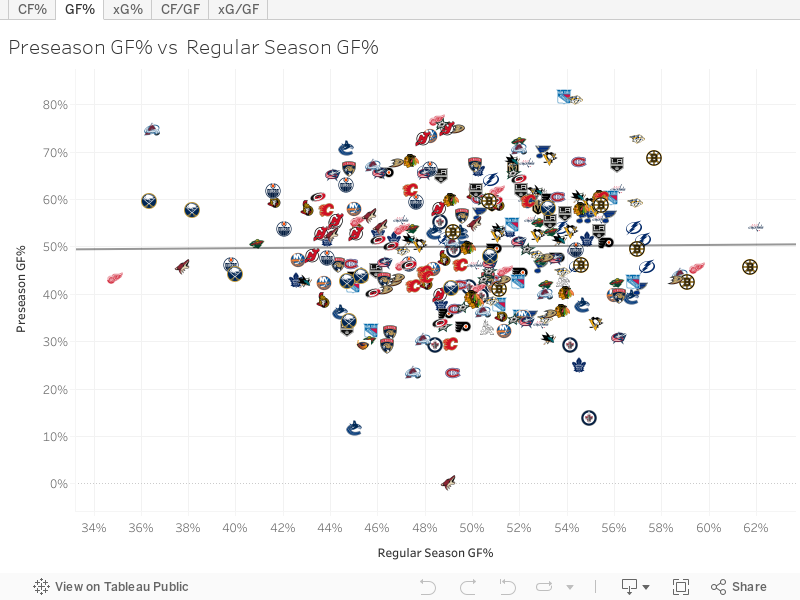
Score one for those who write off the pre-season: there's no noticable correlation between goal differential in the pre-season and in the regular season. In some teams' cases, such as the Panthers themselves, pre-season success on the scoreboard has actually tended to come in years where the team floundered in the regular season. Time to panic, Cats fans?
 |
| Florida's regular season success is negatively correlated with pre-season success. |
Preseason Shot Attempts Mean A Little
 |
| Notice the 2013-14 Sabres? |
Those in the know are well away that shot attempts tend to be a better predictor of future goal differentials than past goal differentials are. Perhaps that makes it less surprising to see that a bit of a correlation shows itself when we change our focus from just goals to shot attempts. The correlation is not very strong, with an r-squared value of just 0.15. That puts it barely above the commonly used 0.10 threshold of statistical significance. Shot attempts do a bit better job of predicting regular season goals than preseason goals, but still correlate together weakly, at an r-squared value of 0.05.
Expected Goals are a Little Worse

Expected goals values in the preseason trend similarly to shot attempts in predicting both expected goals and actual goals in the regular season. The correlation is just a bit weaker, at r-squared of 0.12 for preseason xG to regular season xG, and 0.04 for preseason xG to regular season goals.
Pre-season doesn't mean a lot. So what?
Even if an undefeated pre-season doesn't guarantee that Stanley C. Panther will lift the Stanley Cup come June, a good pre-season still gives fans reasons to get excited about seeing their team hit the ice again, and victory in the pre-season still tastes sweet. The goal of pre-season was never to show teams a litmus of their abilities; it serves as preparation for the intensity of the regular season. The tests players face in the heat of battle are difficult to prepare for without having a sparring partner. You can say "it's just pre-season", but these games still pit two groups of immensely talented, highly competitive professional athletes against one another, and it's very easy to get excited by that. With that in mind, the games don't have to tell us anything, as long as they remind us that regular season hockey is just around the corner.
Thursday, September 30, 2021
Greg Wyshynski, ES... ...PN (Special)
Listen to "Greg Wyshynski, ESPN (SPECIAL)" on Spreaker.
Alex, Jacob, and TJ discuss with Greg;
- ESPN's re-acquisition of NHL TV rights
- Spencer Knight, the great white hope
- How far guys named Sam can take the Panthers
- Some of the quintessential "Florida Panthers" stories through the years
- What Greg is watching on TV
You can find Greg's work on ESPN.com as well as on the Puck Soup podcast and Patreon. Follow him @Wyshynski on twitter but you probably already do, so...
Greg Wyshynski, formerly of Puck Daddy on Yahoo, now on ESPN and the Puck Soup podcast, is our guest for the episode.
Alex, Jacob, and TJ discuss with Greg;
- ESPN's re-acquisition of NHL TV rights
- Spencer Knight, the great white hope
- How far guys named Sam can take the Panthers
- Some of the quintessential "Florida Panthers" stories through the years
- What Greg is watching on TV
You can find Greg's work on ESPN.com as well as on the Puck Soup podcast and Patreon. Follow him @Wyshynski on twitter but you probably already do, so...
Tuesday, September 28, 2021
Making the Band: Florida Panthers
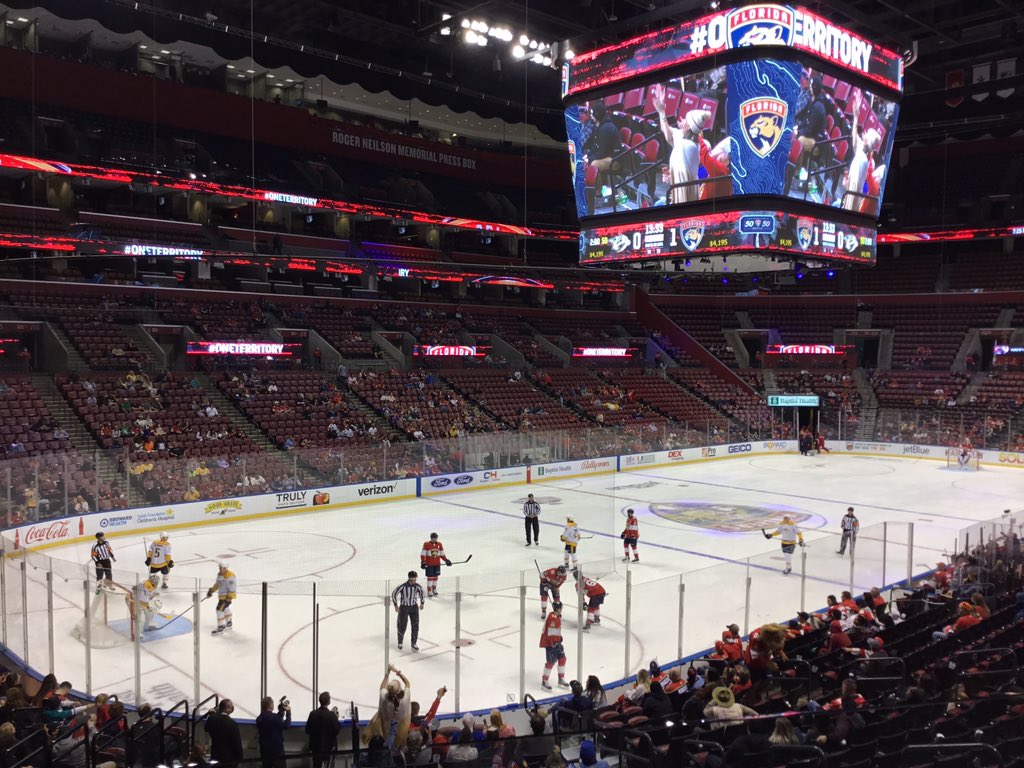 |
| The Florida Panthers take on the Nashville Predators in a preseason game on September 26, 2021. |
Bill Zito’s stellar work in his first two seasons as general manager of the Florida Panthers has presented Joel Quenneville with a number of problems, but these are the kind of problems that any NHL coach would welcome. Despite external worries about the Panthers’ strength in depth, voices in the Roger Nielson Memorial Press Box speculate whether the Panthers have ever had a more difficult lineup to crack for up and coming players.
With lineup spots at a premium, competition for those spots intensifies as training camp gets underway. New faces such as Joe Thornton and (one-time Panthers prospect) Maxim Mamin will get a chance to show the coaching staff what they’re capable of. Established players who had a hand in Florida’s 2021 success, Juho Lammikko and Ryan Lomberg among them, have a steeper standard to reach in order to regularly crack the lineup. Simultaneously, prospects like Anton Lundell and Grigori Denisenko are eager to prove they’re the finished product, ready to fulfill all their potential.
Joel Quenneville has not been one to sit on his laurels when something isn’t clicking. That will grant many of these names the opportunity to play in a Panther uniform in 2021-22. Still, many of these players will find themselves at a significant disadvantage without a platform to demonstrate their capability to perform at the NHL level.
Forwards
What should be made of Anton Lundell’s absence from Panthers training camp? While the young Finn has been lights out in Liiga, World Juniors, and even the IIHF World Championships, he doesn’t have as much experience on North American ice as his rivals for roster spots. There is optimism in the air that Lundell will be an everyday player in Florida, but his spot shouldn’t be taken for granted. Without a full training camp, his chances diminish even further. More on this to come in a future post.
Quenneville rolled out what could be Florida’s bottom 6 forward lines in Thursday’s practice; Joe Thornton centered Mason Marchment and Anthony Duclair on a would-be third line, while Noel Acciari skated down the middle with Frank Vatrano and Patrik Hörnqvist on a possible fourth line.
This leaves the aforementioned Denisenko and Mamin on the outside looking in, along with Finns Aleksi Hepomiemi, Eetu Luostarinen, and Juho Lammikko, who were skating on other lines on day 1 of camp. Luostarinen stepped into Joe Thornton’s spot with Marchment and Vatrano when the 42-year old was not available for Sunday’s pre-season opening doubleheader. Does this make him Quenneville’s “next man up”, giving him an edge on a roster spot when the Panthers cut their group down to twenty-three players? More on this to come yada, yada, yada.
Defense
2021 Waiver claim Noah Juulsen slid in next to Markus Nutivaara on Sunday as Florida opened up their preseason slate, with Radko Gudas missing out with a slight injury. Juulsen has the distinct handedness advantage over some of his would-be blue line competitors if a rightie like Gudas were to exit the lineup with injury. Other defenders on the fringes like Kevin Connauton, Max Gildon, John Ludvig, and Matt Kiersted are all left-handed, while Juulsen is right-handed.
On the other hand, if a leftie were to come out of the lineup, it does seem that 23 year-old Matt Kiersted would be next in line to slot in for Florida on that side of defense. Kiersted was paired with Kevin Connauton on Sunday, who played on his off-side. John Ludvig missed out via injury, while Max Gildon was used in a third-pairing role in the first of two split-squad games vs Nashville. Ludvig, the youngest of the group at age 21, is most likely to be seasoned with playing time in the AHL with Charlotte.
Goaltender
The Panthers’ presumed first-choice goaltending tandem of Sergei Bobrovsky and Spencer Knight was all but confirmed by remarks from Quenneville and the performance of Knight in his preseason outing, juxtaposed with Samuel Montembeault’s less impressive showing earlier in the day. Offseason signing Christopher Gibson did not play at all but seemed to be healthy enough to back up Knight in the second game. Gibson and Montembeault should split games in Charlotte this year, with Monty getting the first call up should a Panther goalie go down injured. Of course, Chris Driedger started as the #4 goalie for the Panthers in 2019-20, and we all know how that went for him, so Gibson might still get a chance to prove himself in the NHL.
Estimated Florida Panthers Depth Chart - 2021-22 Season
Based on lineups used in training camp & preseason
Subscribe to:
Posts (Atom)